
The Cost of Disengagement: What’s Keeping Your People from Bringing Their Best?
Your people may be showing up to work. But are they bringing their ideas, initiative, and strengths with them?
Disengagement can look like a talented employee who stops offering suggestions. A team that waits for instructions instead of taking ownership. People who complete assigned tasks but hesitate to make decisions.
The work continues, but potential stays untapped.
And that untapped potential comes at a cost.
Before assuming people lack motivation, leaders need to ask:
What is making it difficult for our people to contribute fully?
The answer may reveal opportunities to improve not only employee engagement but also leadership effectiveness, productivity, and organizational performance.
The Hidden Business Cost of Disengagement
Disengagement isn’t always obvious. Employees may continue meeting basic expectations while contributing far less than they’re capable of.
Over time, the consequences can extend throughout an organization.
When employees hesitate to share ideas, opportunities for innovation and improvement may be missed.
When leaders struggle to delegate, decisions slow down and work becomes dependent on a few individuals.
When people avoid difficult conversations, unresolved problems can affect collaboration, accountability, and trust.
And when high performers consistently take on more than they can reasonably sustain, organizations risk burnout, declining performance, and turnover.
These challenges affect more than morale. They influence how effectively an organization uses its time, talent, and resources.
The cost of disengagement isn’t simply what employees aren’t doing. It’s the value organizations may be leaving on the table.
Before investing in additional resources or another employee engagement initiative, leaders should consider whether they’re fully leveraging the capabilities already within their teams.
Sometimes the greatest opportunity for improved performance begins by identifying what’s getting in the way.
How Power Leaks™ Interfere with Execution
In my Fully Powered™ Leadership Framework, Power Leaks™ are internal patterns that cause people to give away or limit their power—their ability to make decisions, take ownership, and execute effectively.
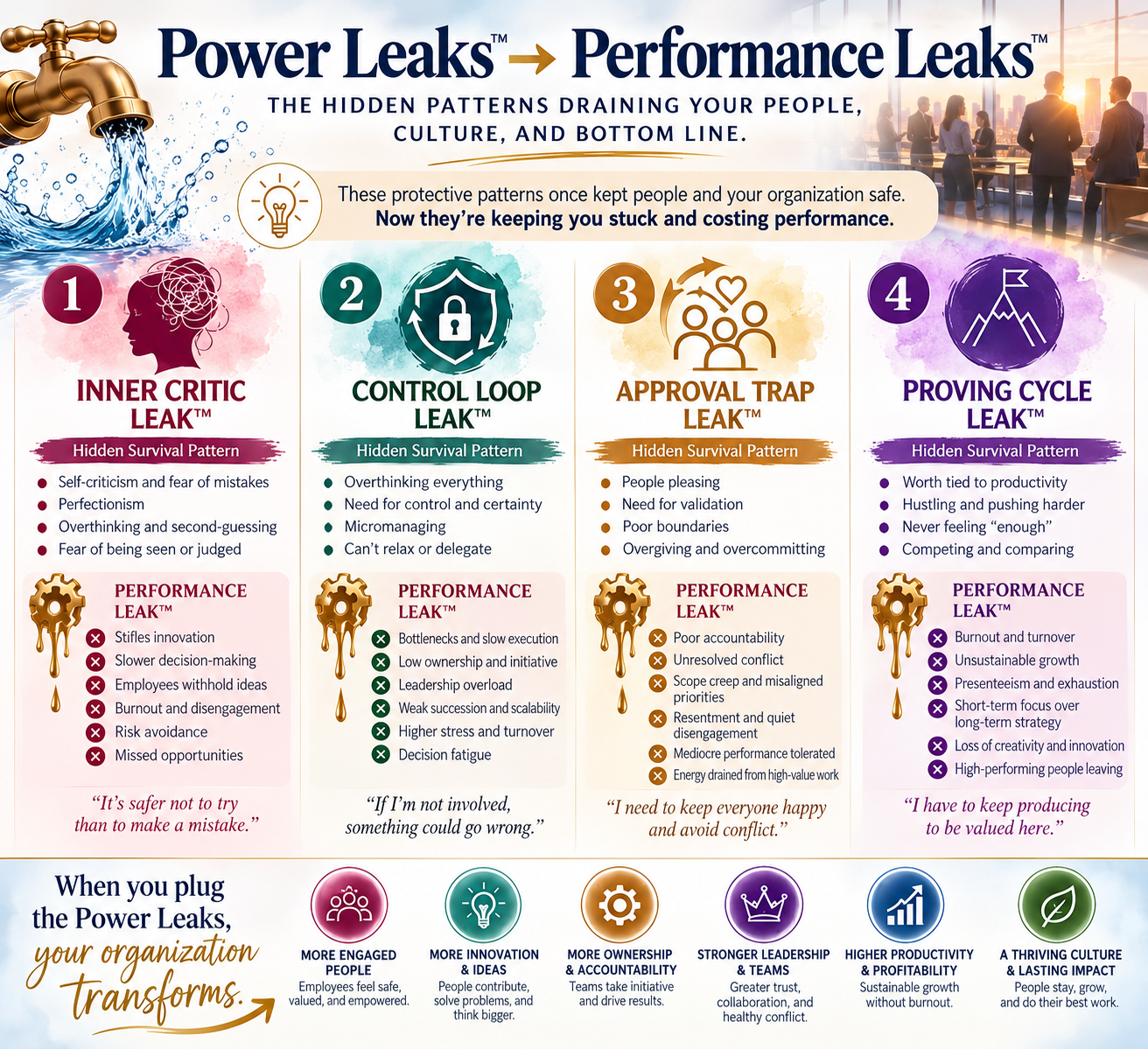
The Inner Critic Leak™ can keep people second-guessing decisions and withholding ideas because they fear making mistakes or being judged.
The Control Loop Leak™ can turn leaders into bottlenecks as they micromanage, override decisions, or struggle to delegate.
The Approval Trap Leak™ can keep people from addressing problems, communicating boundaries, or having necessary conversations.
The Proving Cycle Leak™ can drive people to take on too much, making it difficult to prioritize, delegate, and follow through on what matters most.
These patterns don’t operate in isolation. They can influence the behaviors and expectations of an entire team.
If a leader repeatedly takes over, employees may learn to wait for direction.
If concerns are consistently dismissed, people may stop raising them.
If working longer hours is rewarded more than producing meaningful results, employees may prioritize appearing busy over making progress.
Over time, these behaviors can become part of the workplace culture.
Of course, not every performance or engagement challenge stems from a Power Leak™. Inadequate staffing, unclear expectations, insufficient training, limited resources, and organizational systems can also prevent people from performing effectively.
That’s why Fully Powered™ Leadership examines both the internal patterns influencing behavior and the practical conditions affecting execution.
The goal isn’t to place blame. It’s to identify what’s preventing people from using their capabilities effectively and take meaningful action to address it.
What Does Success Actually Look Like?
Before attempting to improve engagement or performance, leaders need to define what they’re trying to achieve.
What would meaningful improvement look like within your organization?
Perhaps you want employees to make more independent decisions, contribute ideas during meetings, take greater ownership of projects, or communicate challenges before they become bigger problems.
Be specific.
Rather than simply wanting a more engaged team, identify the behaviors that would demonstrate greater engagement.
What would people be doing differently? What outcomes would improve? How would you know progress was being made?
Clarity about the desired outcome makes it easier to identify what’s standing in the way.
Use the POWER Process™ to Move Forward
My Plugging Performance Leaks worksheet guides leaders through five practical steps for addressing recurring challenges and improving execution.
P — Pinpoint Your Power Leak™
Start with your own leadership.
Which pattern might be influencing your decisions, communication, or behavior?
How might you be contributing to the bottleneck?
This requires radical ownership.
Perhaps your Control Loop Leak™ leads you to require approval for decisions you actually want employees to own.
Or maybe an employee’s Inner Critic Leak™ is contributing to hesitation around sharing ideas or making decisions.
Recognizing these patterns creates an opportunity to respond differently.
O — Observe the Bottleneck
Describe what is happening in observable terms.
“They lack initiative” is an interpretation.
“They finish an assignment and wait for me to identify the next task” describes behavior.
What is getting stuck? Where is progress slowing down?
What is the impact on time, ownership, quality, or results?
Focusing on observable behaviors helps leaders move beyond assumptions and identify specific opportunities for improvement.
W — Weigh Your Expectations and Assumptions
What did you expect, and did you communicate it clearly?
What unmet expectation, belief, or assumption might be influencing how you’re interpreting the situation?
Is your expectation realistic given the person’s skills, resources, and decision-making authority?
For example, you may expect employees to make independent decisions without ever defining which decisions they’re empowered to make.
Sometimes what appears to be a performance problem is actually a clarity problem.
E — Explore the Real Barrier
Have a conversation from curiosity before deciding what’s causing the problem.
Ask questions such as:
- What’s getting in the way?
- What feels unclear?
- What support or resources would help?
- What decisions do you feel empowered to make?
- What would help you move forward more confidently?
The barrier could involve workload, training, competing priorities, motivation, accountability, or a lack of decision-making authority.
Listen to understand rather than immediately jumping to a solution.
The goal is to uncover the real barrier so your response addresses the problem rather than just its symptoms.
R — Respond and Review
Choose an action that addresses the barrier you’ve identified.
Define what you will change, what the other person will own, and when you will follow up.
Agree on observable signs of improvement.
For example, clarify decision-making boundaries, identify which responsibilities employees can manage independently, and review progress after two weeks.
The review matters because lasting improvement requires more than a single conversation.
It requires consistent leadership behaviors, clear expectations, and accountability.
What This Looks Like in Practice
Imagine a department where employees rarely make decisions without their manager’s approval.
Projects are moving forward, but progress is slower than expected. The manager feels overwhelmed by constant questions, while employees appear reluctant to take initiative.
Initially, the manager assumes the team needs to become more proactive.
But after examining the situation through the POWER Process™, a different picture emerges.
The manager recognizes a Control Loop Leak™.
Because they want to ensure everything is done correctly, they’ve developed a habit of reviewing nearly every decision, stepping in when something isn’t handled exactly as expected, and taking over when deadlines become tight.
Over time, employees have learned that it’s safer to ask permission than exercise their own judgment.
The manager’s need for control has unintentionally created the very dependency they’re frustrated by.
Rather than immediately sending employees to another training or asking them to demonstrate more initiative, the manager changes their approach.
They clarify which decisions employees can make independently, establish expectations for when escalation is necessary, and create space for employees to take ownership.
They also commit to resisting the urge to step in unnecessarily.
Two weeks later, the manager reviews whether employees are making more decisions independently, whether fewer routine approvals are required, and whether projects are progressing more efficiently.
This is a hypothetical example, but it illustrates an important leadership principle:
Sometimes the behavior leaders want to change in their employees requires a change in their own leadership first.
And sometimes the solution isn’t adding more resources. It’s removing the barriers that prevent people from effectively using the resources they already have.
Unlock the Power to Execute
Disengagement leaves valuable potential untapped.
And while organizations often focus on what employees need to do differently, meaningful improvement also requires examining the leadership behaviors, expectations, and workplace conditions influencing performance.
Power Leaks™ provide a way to recognize internal patterns that may be interfering with decision-making, ownership, collaboration, and execution.
The POWER Process™ offers a practical approach for identifying barriers and taking action.
Fully Powered™ Leadership helps leaders and teams better leverage their existing strengths, judgment, talent, and resources—while creating the conditions for others to do the same.
Because organizational performance isn’t simply about how many people or resources you have.
It’s also about how effectively you’re using what is already available.
What could your organization accomplish if your people were better equipped and empowered to bring their best?
Ready to Build a Fully Powered™ Organization?
What if your organization’s next performance breakthrough isn’t about hiring more people, adding another initiative, or asking employees to work harder?
What if it begins by unlocking more of the potential already within your team?
Through the Fully Powered™ Leadership Framework, I help organizations identify hidden Power Leaks™, strengthen leadership effectiveness, and address the barriers that prevent people from taking ownership, contributing their strengths, and executing at their best.
Through leadership keynotes, interactive workshops, and leadership development experiences, we explore how to:
- Recognize the patterns that create leadership bottlenecks and limit performance.
- Strengthen decision-making, delegation, and accountability.
- Create conditions that support employee engagement, trust, and initiative.
- Better leverage the talent, strengths, and resources already within the organization.
Let’s explore what’s possible for your leaders, your people, and your organization’s performance.
📩 Email me: [email protected]
💬 Or connect with me on LinkedIn to start a conversation about bringing Fully Powered™ Leadership to your organization.
Because when leaders become Fully Powered™, they create the conditions for people to contribute more fully—and organizations to achieve stronger results.
Dr. Christina Fontana | Leadership Expert | Creator of the Fully Powered™ Leadership Framework
execute.