

How do you get to the root cause of a recurring leadership issue? That is at the heart of this blog where we’ll explore what I call Internal Friction and Power Leaks that contribute to these challenges.
As an example…
“I wish my team would take more initiative.”
Maybe you’ve said this after answering a question someone could have handled on their own. Or after watching a project stall because everyone was waiting for you to make the next decision.
Now think about the last time someone on your team made a decision you would have made differently. Did you ask them to walk you through their thinking? Did you let the decision stand? Or did you step in and redo it yourself?
Your team pays attention to what happens in those moments. If their decisions are routinely overturned, waiting for your approval starts to make sense. And every time they wait, it can reinforce your belief that you have to stay involved in everything.
That’s the iceberg I explore in The Fully Powered™ Leader. Above the surface, you see the problem that keeps coming up. Beneath it, you may find beliefs, assumptions, and habits that help explain why it keeps coming back.
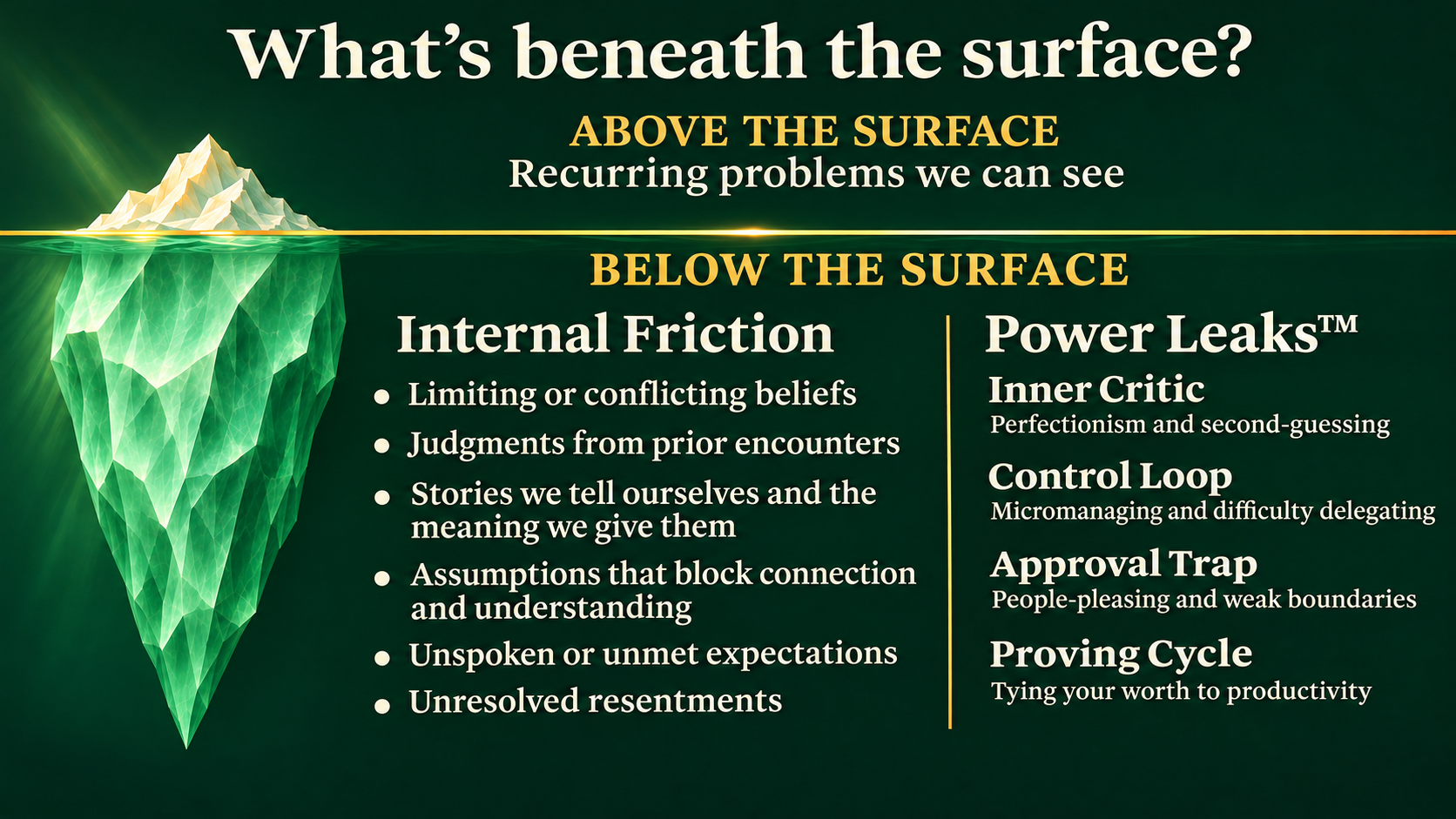
The Internal Friction beneath a recurring problem
In my Fully Powered Leader book, I call it Internal Friction when what we intend to do runs up against a competing belief, emotion, assumption, or protective habit.
You may genuinely want your team to take ownership. You may also believe that if something goes wrong, it will reflect poorly on you. So when a team member takes a different approach, you feel the urge to step in. You might notice it in a tight jaw, a held breath, or how quickly you start telling them what to do.
Internal Friction can also come from a judgment you formed after one difficult encounter, an expectation you never made explicit, or a resentment you’ve carried into the next meeting. A missed deadline can turn into I can’t count on her, even though you’ve never asked what got in the way or clarified what you expect next time.
As I write in the book, what you carry consumes your capacity. It also shapes how you respond to the person in front of you.
Four Power Leaks™ leaders can spot at work
Power Leaks™ are recurring protective patterns that can create Internal Friction and keep important matters unresolved. Here’s how they can show up in a regular workweek.
- The Inner Critic. You second-guess a decision you’re equipped to make and spend another week gathering input while your team waits for direction.
- The Control Loop. You delegate a project, then review and revise every detail. The person doing the work learns that you’ll still make the final call.
- The Approval Trap. You soften feedback so much that the employee leaves the conversation unaware that anything needs to change.
- The Proving Cycle. You take on work someone else could own because being the person who always delivers has become part of how you measure your worth.
These habits can feel responsible, considerate, or committed in the moment. Their effects become easier to see when you look at what keeps getting delayed, avoided, or handed back to you.
How an avoided conversation becomes an Open Loop
In The Fully Powered™ Leader, I share the example of a leader who needs to address a performance issue but worries about how the employee will respond. The Approval Trap is the pull to preserve the employee’s approval. The Internal Friction is the tension between wanting to give honest feedback and imagining the other person’s reaction. The Open Loop is the conversation that keeps getting postponed.
Meanwhile, the employee may have no idea how serious the issue is. The leader spends more time thinking about it, frustration builds, and the same problem shows up again.
An Open Loop can be an unfinished conversation, an unmade decision, or a commitment nobody has clearly taken ownership of. Naming what’s open makes it easier to decide what would actually move the work forward.
Leadership Lab | Look beneath one recurring problem
Choose one issue that has frustrated you more than once this month. Give yourself five minutes to answer these questions.
- What can I observe? Write down what happened. “Three routine decisions came back to me for approval” gives you more to work with than “Nobody takes initiative.”
- What am I assuming? What story am I telling about the people involved? What expectation might I have left unspoken?
- How might my response be shaping what happens next? Look at where you step in, hold back, take on too much, or delay a conversation. Also check whether the team has the time, skills, and authority to do what you’re asking.
- What can I resolve this week? Choose one decision to make, one conversation to initiate, or one responsibility to clarify.
If your team keeps coming back to you for approval, try handing over one specific decision with clear boundaries. You could say, “You own the decision on this. Here’s what we need to achieve, and here’s when I want you to bring me in. At our next check-in, I’d like to hear what you decided and how you got there.”
Then give them room to make the call. If they choose a sound approach that differs from yours, let them follow it through. That moment gives them a reason to take initiative the next time.
I see this as part of stewardship. Leaders have a responsibility to develop the people entrusted to them. Sometimes that starts with noticing how quickly we take the work back and giving someone the authority and support to carry it.
If your organization is working through recurring challenges with initiative, delegation, or follow-through, I bring the Fully Powered™ Leadership Framework to teams through keynotes and leadership workshops. Explore speaking and workshops with Dr. Christina Fontana.