
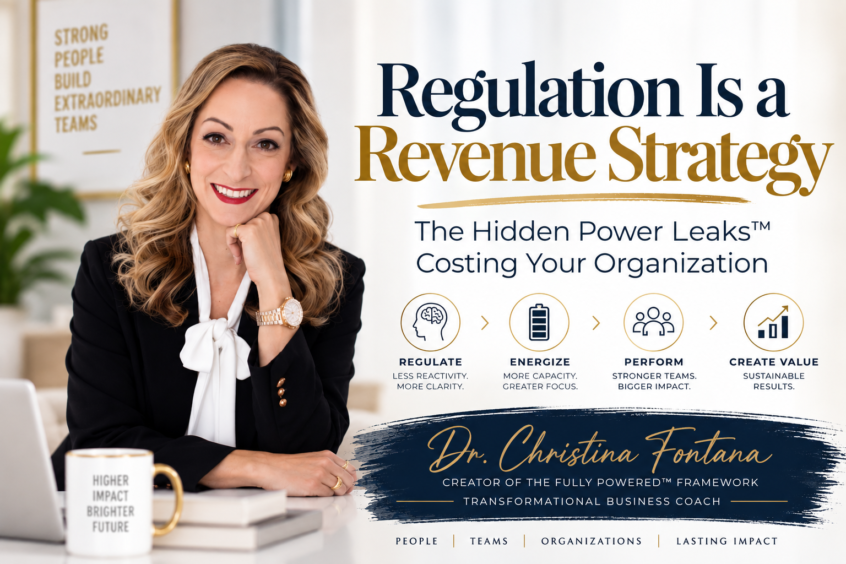
Regulation Is a Revenue Strategy
What if some of the biggest threats to performance aren’t showing up on your P&L?
They’re showing up in your people.
In the leader who feels like they constantly have something to prove. The executive who second-guesses their decisions. The manager who struggles to let go of control. The employee who avoids saying what needs to be said because they don’t want to disappoint anyone.
I call these Power Leaks™.
Because power isn’t simply energy. Power is your ability to execute.
And every Power Leak™ consumes something incredibly valuable to an organization: the capacity to execute effectively.
The capacity to think clearly, communicate, collaborate, innovate, make decisions, lead, serve clients and solve problems.
That’s why I believe regulation isn’t simply a wellness strategy.
Regulation is a revenue strategy.
The Research Is Getting Our Attention
Research on teams gives leaders compelling reasons to pay attention to energy and the human experience of work.
In one study, researchers analyzed 54 actual workplace team meetings and found that patterns of humor and laughter were associated with positive communication, better procedural structure, new solutions and team performance. The relationship with performance was also seen in supervisor ratings two years later, although job insecurity influenced the effect.
Another study looked at 2,159 employees across 417 workplace groups. Positive group emotions such as enthusiasm, optimism, satisfaction and comfort were connected to performance through social resources including cohesion, coordination, teamwork and a supportive team climate.
A separate study of 245 working professionals found workplace fun was positively related to organizational citizenship behavior and indirectly related to task and creative performance, with engagement playing an important role.
And while reading Peter Hawkins’ Leadership Team Coaching, another phrase caught my attention. In discussing Katzenbach and Smith’s work on high-performing teams, Hawkins highlights high levels of enthusiasm and energy as one of their characteristics.
Energy keeps showing up.
But energy alone isn’t the whole story.
The bigger business question is whether people have access to the power they need to execute.
And what happens when they don’t?
You Can’t Tell People to Have More Fun
This research isn’t telling CEOs to install a ping-pong table.
Fun isn’t the intervention.
The better leadership question is: What is interfering with our people’s ability to execute at their highest level?
That’s where the Fully Powered™ Framework comes in.
At the heart of the framework are four Power Leaks™ I see repeatedly in high-achieving people and leaders.
The Proving Cycle
The drive to continually prove your value through achievement. It can look like overworking, overdelivering, pushing beyond your capacity and tying your worth to your results.
The Inner Critic
The internal voice that fuels self-doubt, perfectionism and second-guessing. Instead of using your power to decide and move forward, valuable capacity gets consumed questioning whether you’re doing enough, doing it right or are good enough to begin with.
The Control Loop
The belief that maintaining control is necessary to ensure success. It can show up as micromanaging, difficulty delegating, overplanning or feeling responsible for everything and everyone.
The Approval Trap
The need for approval, acceptance or validation that can make it difficult to set boundaries, have hard conversations, challenge ideas or make decisions that might disappoint someone.
These patterns may be deeply personal, but their impact doesn’t stay personal.
They walk into meetings, influence decisions, affect communication and shape how leaders delegate, collaborate, handle conflict and respond under pressure.
Imagine how much organizational power can be consumed when one leader is constantly proving, another is second-guessing themselves, another can’t relinquish control and another is avoiding the conversation everyone knows needs to happen.
That is why Power Leaks™ are a business issue.
Regulation Helps Us Reclaim Power
People can perform while operating inside these patterns. Many high performers do.
Until they can’t.
But even before performance visibly declines, there can be a cost.
Power spent proving isn’t available for creating. Power spent second-guessing isn’t available for deciding. Power spent controlling everything isn’t available for empowering others. Power spent seeking approval isn’t available for courageous leadership.
This is where regulation becomes more than a wellness conversation.
Regulation can help us recognize the patterns driving our behavior, interrupt automatic responses and regain access to more of our capacity to choose how we lead and execute.
That is what I mean by becoming Fully Powered™.
It doesn’t mean having endless energy or being positive all the time. It means having greater access to your power and being able to direct it toward what creates the most value.
What Does a Fully Powered™ Team Look Like?
A Fully Powered™ team doesn’t mean everyone is happy all the time.
High-value teams still experience pressure, conflict, deadlines and difficult conversations. The difference is that they have greater capacity to navigate those challenges without unnecessary depletion.
There is room for trust, connection, creativity, enthusiasm, constructive disagreement and yes, humor and laughter.
The laughter isn’t the KPI. It can be a signal of something deeper happening within the team.
Peter Hawkins takes this even further by challenging leadership teams to consider the value they create for their stakeholders, not simply how well they function internally.
That’s the ultimate business question: Do our people and teams have the capacity to continually create value for the employees, clients, customers and other stakeholders who depend on them?
Revenue doesn’t happen in isolation. People create the ideas, solve the problems, make the decisions, build the relationships, serve the clients and create the value.
And when too much of their power is being consumed by Power Leaks™, there is less available for all of it.
So perhaps leaders need to stop asking, “How do we get more out of our people?” and start asking, “What is interfering with our people’s ability to execute at their highest level?”
You don’t build a Fully Powered™ organization by continually asking people to do more. You build one by identifying the Power Leaks™ that are consuming their capacity to execute.
Because power is the ability to execute.
And when people can reclaim that power, they have more capacity to lead, create, collaborate, solve problems and generate value.
That is why regulation is a revenue strategy.
Research Referenced
Lehmann-Willenbrock, N. & Allen, J. A. (2014). “How Fun Are Your Meetings? Investigating the Relationship Between Humor Patterns in Team Interactions and Team Performance.” Journal of Applied Psychology, 99(6), 1278–1287.
Peñalver, J., Salanova, M., Martínez, I. M. & Schaufeli, W. B. (2019). “Happy-Productive Groups: How Positive Affect Links to Performance Through Social Resources.” The Journal of Positive Psychology, 14(3), 377–392.
Fluegge-Woolf, E. R. (2014). “Play Hard, Work Hard: Fun at Work and Job Performance.” Management Research Review, 37(8), 682–705.
Hawkins, P. Leadership Team Coaching.
Katzenbach, J. R. & Smith, D. K. The Wisdom of Teams.